







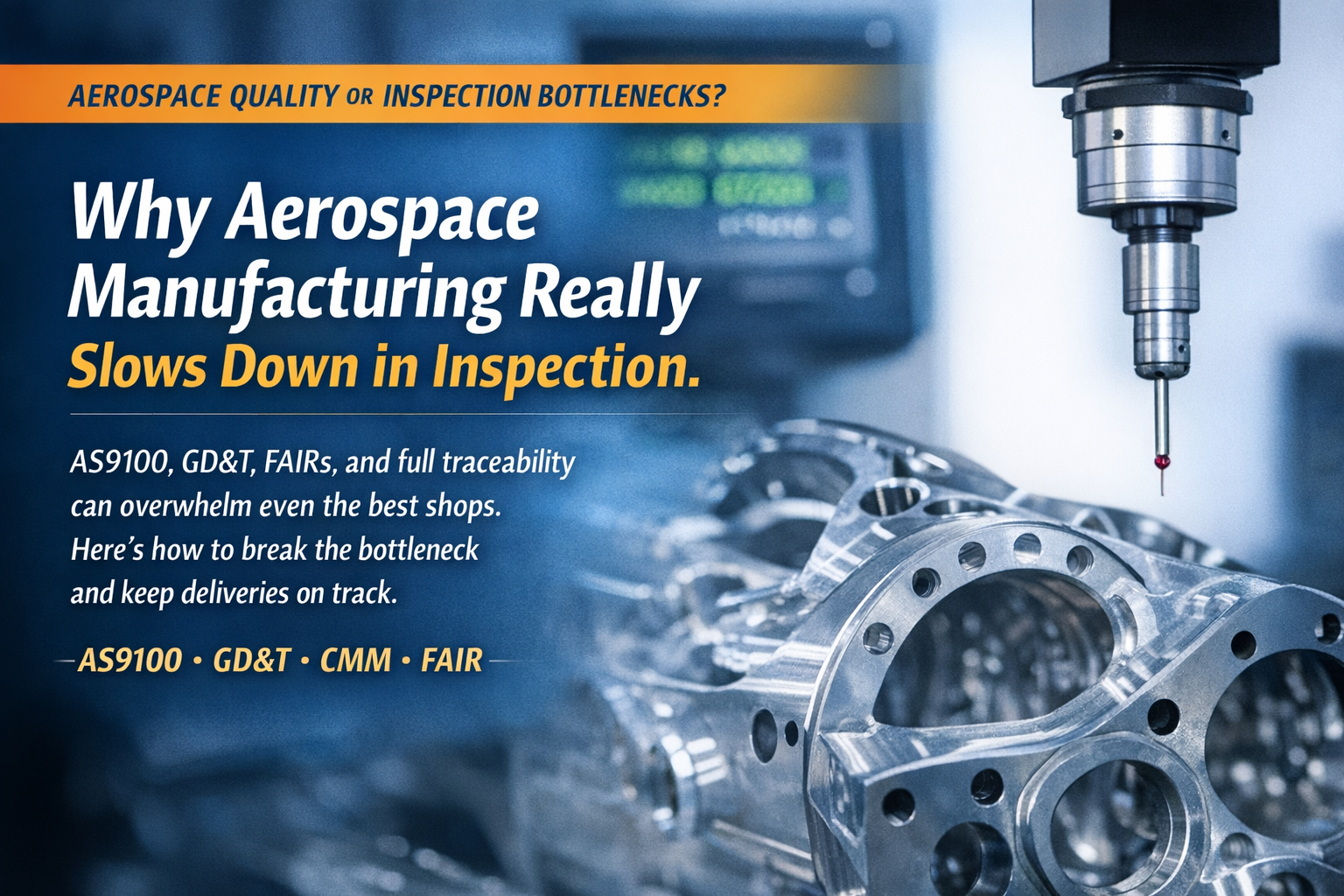
When Aerospace Quality Slows You Down — And How to Stay Ahead of It
In aerospace manufacturing, quality is not optional. It is the product.
Every dimension, every datum, every note on the drawing exists for a reason—because in this industry, a single miss can lead to catastrophic failure. That level of responsibility is what separates aerospace machining from everything else. It’s also what quietly brings many shops to their knees: inspection overload.
At O&Y Precision, we live this reality every day. We’ve seen how aerospace requirements can turn a clean production schedule into a bottlenecked inspection room overnight. The irony? The parts are done. The machines are running. Customers are waiting. But nothing ships until inspection says it can.
This is the story of why that happens—and how to prevent it.
The Hidden Weight of Aerospace Inspection
Aerospace inspection is not “checking a few critical features.” It is a full forensic investigation of a part.
It includes:
-
100% dimensional verification
-
Complex datum alignment and profile analysis
-
Tight GD&T requirements across compound geometry
-
Material traceability, heat treat verification, and plating certs
-
AS9100-compliant documentation and FAIR packages
-
Engineering reviews, SDRs, and customer communication when anything looks questionable
Each of those steps is reasonable on its own. Together, they create a perfect storm.
When production scales up—or when several complex parts land in QC at the same time—the inspection room becomes the constraint. CMMs are tied up. Inspectors are reviewing data instead of running programs. Engineers are pulled in to disposition edge cases. Reports pile up. Shipping stalls.
This is how good shops miss delivery dates—not because of machining, but because of inspection saturation.
Why This Happens (Even at Good Shops)
Most inspection bottlenecks aren’t caused by poor quality. They’re caused by lack of structure.
Common failure points include:
-
Parts released to QC without inspection prioritization
-
Drawings with ambiguous callouts discovered too late
-
No defined QC “gates” during machining
-
Inspectors overloaded with both programming and report review
-
SDRs discovered at final inspection instead of earlier operations
-
FAIRs and production inspections competing for the same resources
When everything is treated as urgent, nothing moves fast.
The Shift: From Reactive to Controlled
The solution isn’t hiring one more inspector or buying another CMM—though those help. The real fix is process discipline.
Here’s what actually works.
1. Build Inspection Gates Into Machining
Waiting until final inspection to discover issues is a guaranteed delay.
Instead:
-
Perform interim inspections after major operations
-
Lock down datums early and verify them before proceeding
-
Catch profile and positional drift before the part is fully finished
Early inspection saves exponential time later.
2. Separate “Running CMM” From “Reviewing Data”
One of the biggest slowdowns is asking inspectors to do everything.
High-performing shops separate:
-
CMM operation and program execution
-
Data review, drawing reconciliation, and report generation
This keeps machines running and prevents reports from becoming the bottleneck.
3. Prioritize Inspection Like a Production Schedule
Not all inspections are equal.
FAIRs, source-inspected parts, and ship-set-critical components must be prioritized ahead of routine production checks. Inspection needs its own schedule, its own backlog review, and its own daily stand-up—just like machining.
If QC isn’t scheduled, it will always fall behind.
4. Standardize AS9100 Documentation
Inspection doesn’t end at measurement—it ends at paperwork.
Standard templates, checklists, and report structures dramatically reduce review time and errors. When inspectors aren’t reinventing the wheel for every job, throughput improves immediately.
5. Treat SDRs as Process Feedback, Not Failures
In aerospace, deviations happen. Complex parts move. Material relieves stress. Reality doesn’t always match CAD.
The key is speed and clarity:
-
Identify issues early
-
Communicate clearly
-
Provide technical justification backed by data
-
Keep SDRs moving, not lingering
Fast SDRs keep parts flowing and customers informed.
The Real Goal: Predictability
Customers don’t just want perfect parts.
They want predictable delivery.
The shops that win in aerospace aren’t the ones with the fastest machines—they’re the ones with the most controlled inspection flow. When inspection is planned, resourced, and respected as a production function, everything else aligns.
At O&Y Precision, we’ve learned this the hard way—by being buried in reports, by missing sleep over inspection backlogs, and by rebuilding our QC process from the ground up. Today, inspection is no longer an afterthought. It’s a managed system.
Because in aerospace, quality isn’t what slows you down.
Unmanaged quality is.